Exit 8
On a winter’s night in Tokyo some eleven years ago, I strayed from the pack in search of J-Rock CDs for my sister and found myself supremely lost. After mistaking the H&M in Harajuku for the H&M near Shibuya Crossing (my starting point), panic compounded when my phone died and I could no longer rely on Google Maps to navigate my way out. For a person with a faulty internal guidance system, it was a real shituation. Thankfully, Tokyo was clean, well-lit and crawling with people to ask for directions to the nearest train station, so I made it back to my friends without much drama.
Now, if I’d gotten to the train station and found myself lost in a sparsely populated stretch of underground tunnel with an exit that never arrived, I imagine the experience would’ve been a lot scarier.
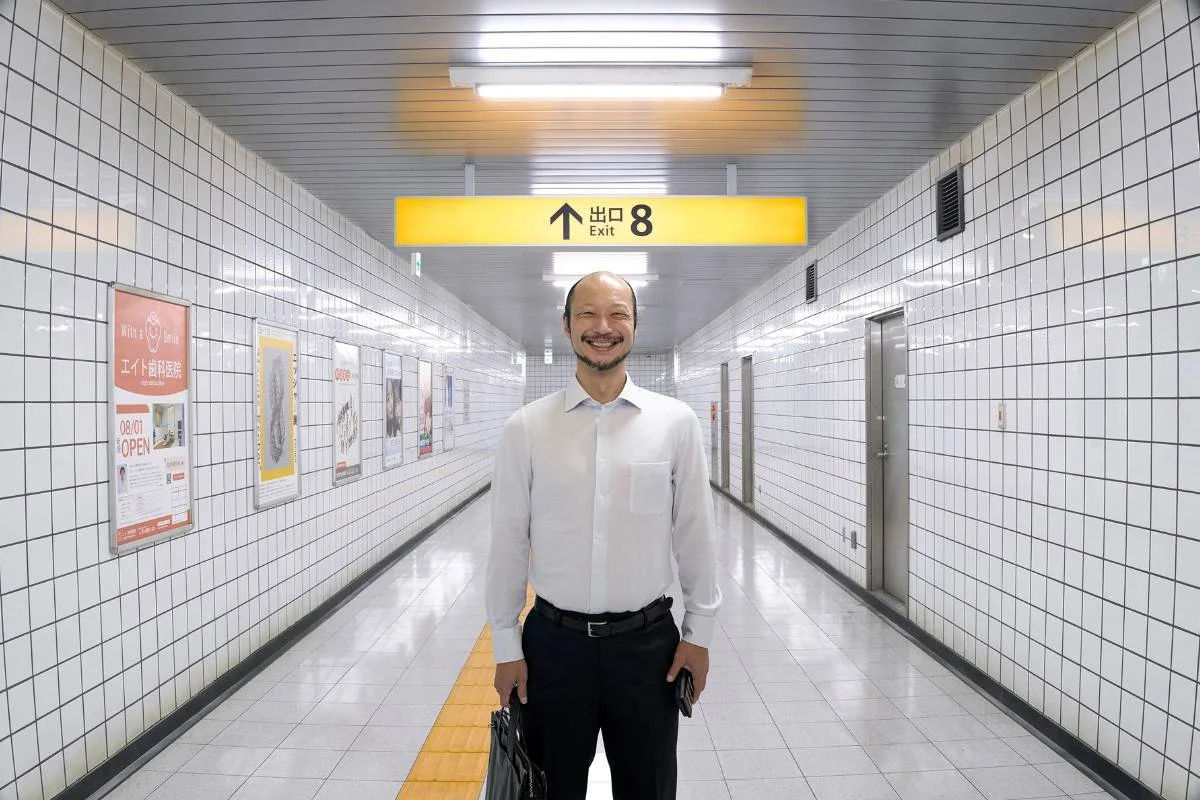
Such is the premise of Exit 8, the film adaptation of the 2023 indie game The Exit 8 in which you, the player, must walk through a neverending Japanese metro station passageway spotting ‘anomalies’ and turning the other way in order to progress from Exit 0 to Exit 8. It’s a concept that uses liminal space (much like Backrooms, which I am eagerly anticipating) on a loop as horror but as I understand (I’ve not played the game), it’s not exactly brimming with material to pad out a full feature film.
Thus, I entered Exit 8 expecting a high-concept walking simulator with some creepy puzzles and claustrophobia. And I got it, though with some light pronatalist propaganda (I kid, kind of) thrown in to up the emotional stakes and dilute the dread.
The film opens with a salaryman (Kazunari Ninomiya) on a packed subway, drowning out his surroundings – which include a screaming baby and a screaming passenger – with his earbuds. He’s dodging calls from his ex-girlfriend but upon finally answering, learns that she’s at the hospital, pregnant and wanting his input on what to do. This POV protagonist is aptly named The Lost Man and like in many of the salarymen vlogs my YouTube algorithm has been serving me, he takes us with him on the long walk from the platform to the station exit.
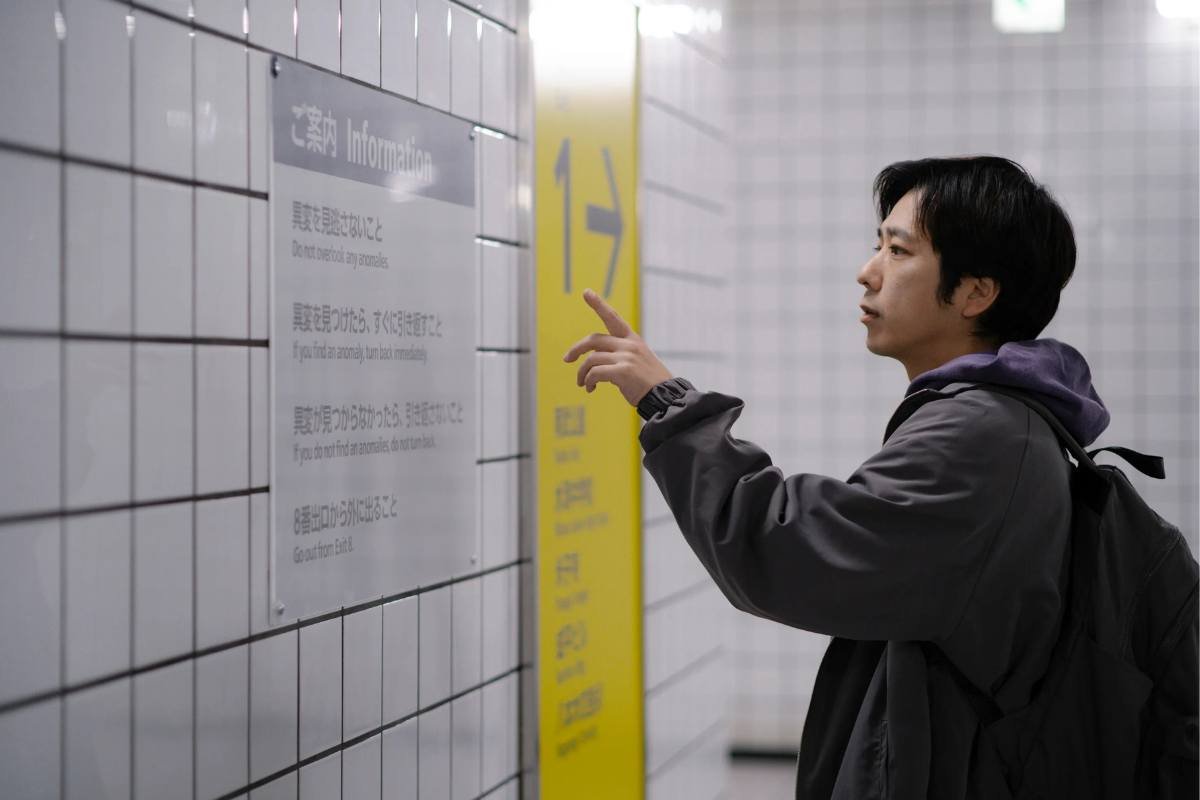
Only, the exit never comes. White tiled hallway blends into white tiled hallway and like the hobbits in The Two Towers, it’s because he’s been here before, he’s going in circles! On maybe his fourth time approaching the Exit 0 plaque he stops and notices some instructions.
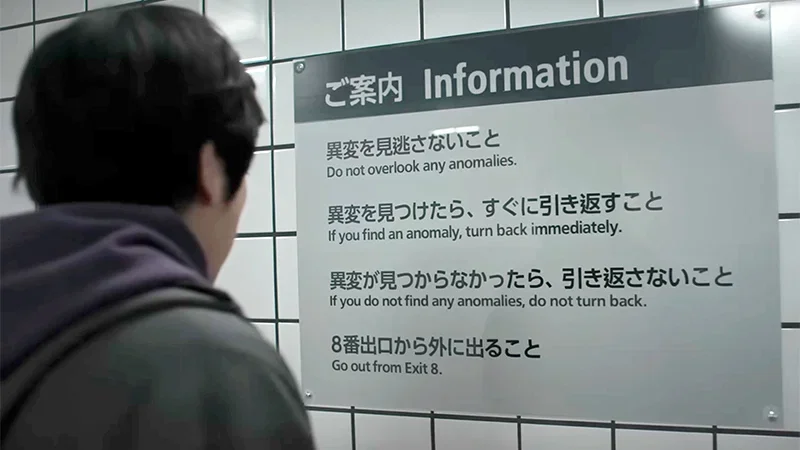
With a new gameplan, he sets out on an adventure. He’ll need patience, attention to detail and the confidence to make a decision and stick with it. Uh oh, is that a metaphor for parenthood I smell?
Exit 8 is a reasonably stimulating mystery film that tickles my fancy for liminal spaces and the psychological torment of being stuck in a seemingly inescapable loop. A straight adaptation of the game might’ve been monotonous but director Genki Kawamara changes up the perspective and cinematography, allowing the audience to exist outside of The Lost Man’s POV and therefore explore some of the other characters’ backstories.
There’s hefty cultural commentary to be found in the film’s symbolism, from the Escher poster depicting worker ants in a constant figure eight to The Walking Man, an entity within the passageway who serves as a cautionary tale for what happens if you abandon the puzzle. My problem with the film is that Kawamara adds another layer that I don’t think is necessary and actually cheapens the salaryman inertia theme and the overall tension of the film.
In the film adaptation, The Lost Man is not just some poor unfortunate soul who stumbled upon the tunnel by chance. That would make the whole thing scarier. Rather, the loop represents the crossroads he is at in his life and his indecision on whether to embrace the opportunity for fatherhood or reject it.
I think in adapting the material, Kawamara added this aspect because he believed the film needed ‘more’ than what the game had to offer. And certainly, with global birth rate decline appearing in the news almost weekly at this point, it would seem a relevant topic – especially for Japan, who’ve been trying seemingly everything to tackle the issue – to include as cultural commentary in a Japanese film. I’m just not sure it works harmoniously with the film’s other elements.
Yes, there’s more to life than your 9-5 (or your 9-9, in the salaryman’s case), but I would argue that having a child with your ex is not quite the emancipation you think it is, and that there are other options outside option 1. be a salaryman and option 2. be a family man. Acknowledging my childfree bias, and that it may be causing me to react negatively to what might be a totally valid plot point to others, I feel that at the very least, this ‘pondering parenthood’ layer clouds an otherwise clean and simple premise. It also adds a few saccharine, emotionally cheap scenes to the film that dragged me out of the nightmare and made the resolution feel more expected than thoughtful.
Complaints aside, Exit 8 is still a decent, mostly satisfying psychological thriller that should appeal to fans of rule-based horror (like The Platform and Cube) or in-a-loop sci fi (like Coherence and The Endless). If anything, watching it and having some gripes has made me more keen to play (or rather, watch Alex play) the game and experience it in its purest form. Nice cross-promotion, Toho and Kotake Create!